Showing posts with label Scottish winter climbing. Show all posts
Sunday, 30 March 2014
A Scottish Winter Season Missed
"The mountains will still be there next time..."
This is a phrase commonly used by climbers to console those who have missed an opportunity, failed on a climb, or retreated for safety reasons. It can be a great comfort. Unlike us, mountains do not wither or grow old, and they endure for millennia. This anchor, steady at the core of a long life filled with change, is part of the great attraction of the hills. It helps to give structure to our lives.
But sometimes these words fail to console. For the youngster new to the hills, every experience is precious and a missed opportunity can be a heavy blow; and for the old hand who is exiled from the mountains he loves, even if that exile is endured willingly and for the very best of reasons, every trip to the mountains is so valuable.
This is the first time in eight years that I have missed an entire Scottish winter mountaineering season. My one and only visit was in January this year, aborted due to high winds, and I didn't get near a single summit. My February trip was cancelled due to bad conditions, and my next chance for a trip to the hills won't come until June.
Since my first trip to Scotland in 2006 I have returned several times a year. Between 2008 and 2011 I lived in Glencoe and climbed several times a week. I have broken crampons, worn out ice axes, reduced expensive Goretex jackets to rags. Winter mountaineering is a big part of who I am and, when faced with the prospect of an entire season of exile, I find myself affected in ways I never would have expected. The yearning is there, of course; frequently unconscious, but then I will see a shaft of sunlight glancing across the meadow on my walk to the bus stop, or perhaps low-lying mist in the field from my study window, and in a flash I'm back on the mountain experiencing moments of danger or beauty. These flashbacks have the power to make me stop in my tracks and gasp.
I know of nothing else in life that has the ability to shape the human mind so powerfully, even years after the events in question. It's remarkable.
There is a positive side. When I lived in Scotland I found myself taking these wonders for granted. I started staying in bed on the less than perfect days, or dismissing an "ordinary" ascent of Stob Coire nan Lochan as boring. Now that I live far from the hills every single mountain experience is precious to me and far more valuable than it was before.
I find that this altered perspective fuels my writing, too. It's my curse that I am never able to effectively write about mountains while I live amongst them: I need time and distance to see them in their proper proportions.
I choose to live in Lincolnshire for many reasons, and I would never go back to the Highlands now: too much of my life is here, and I am well aware that returning to live in Scotland would make me unhappy. As someone who grew up far from the mountains I'm best able to appreciate them with regular visits — but visits firmly separated from the rest of my life.
What I struggle to deal with is when the intervals between these visits grow too long. Work has gobbled up more of my time than I would have liked these last few months, and I'm seeking to rebalance the scale. Until I do I'm sure I will continue to miss the hills — and to try and use that sense of longing to fuel the fires of my writing.
Tuesday, 18 March 2014
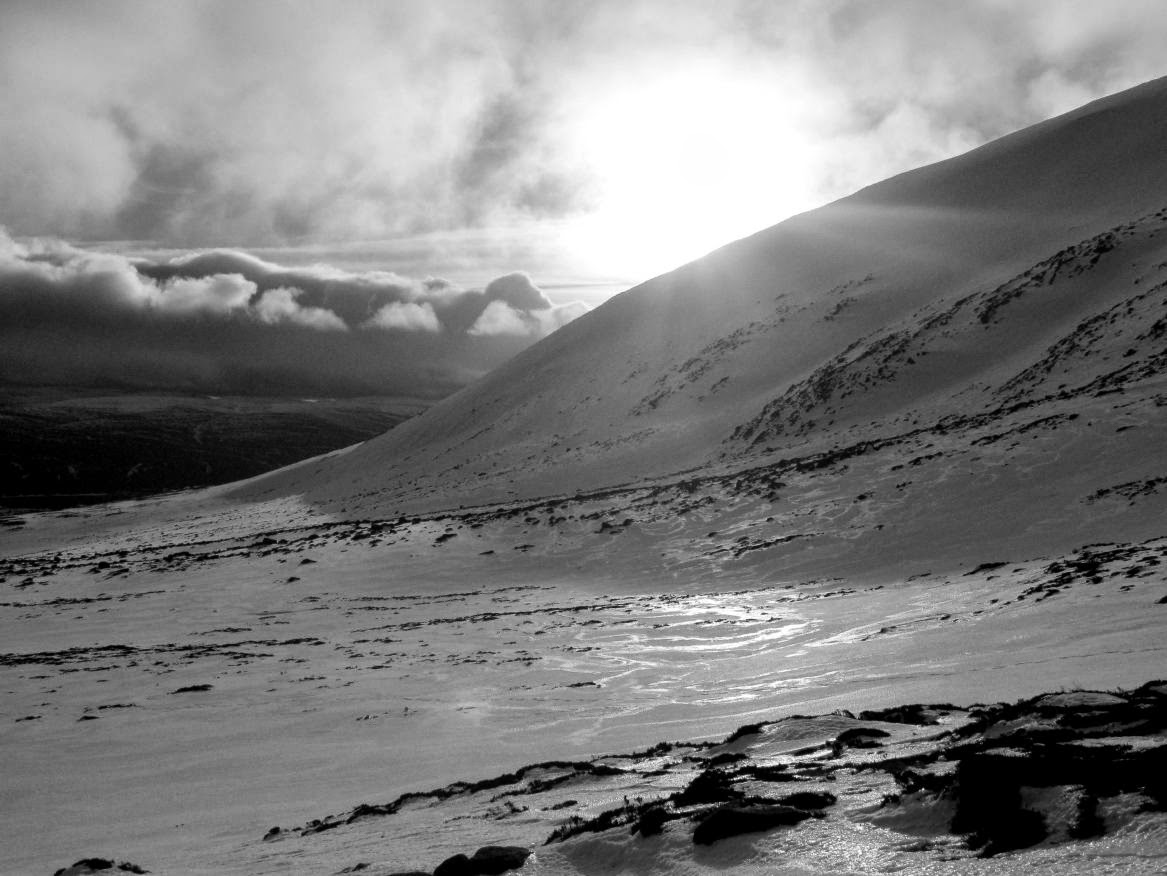
Scotland's last glacier ... as it appears in the present day!
![]() |
| Photo (C) James Roddie 2014, all rights reserved |
However, the research has been mired in controversy since the original paper was published. Rival scientists have challenged the claims and it now appears that the entire question hinges on arcane matters such as soil pits.
A definitive answer to the question "When did the last Scottish glacier die?" may be a little way off, but in the meantime we can gaze in awe at views like the one above and think back to what it must have been like.
The Great Slab of Coire an Lochain
The topography of Coire an Lochain is unusual. At the base of the cliffs, a gigantic slab of polished rock tilts down at a steep angle. Snow builds up on this slab during the winter months and it is often the site of spectacular, full-depth avalanches later in the season.
During thawing conditions like at present, the snowpack can slump and begin to drift down the slab, producing the dramatic crevasses clearly visible in the picture above. The effect is accelerated when the underlying ground isn't that cold (again, this closely mirrors current conditions).
The scale is altogether different, but here's a photo of a glacier in the Alps for comparison.
In this picture we can see genuine glacial crevasses caused by the gradual downhill movement of masses of ice over many centuries. This slope is also prone to avalanche - you can see huge blocks of debris that will testify to that, and many climbers have died here over the years - but it isn't a transient feature like the Coire an Lochain "glacier" is in the present day. The maze of crevasses will change year by year as the entire mass slowly drifts downhill, but it will be possible for a glaciologist to "track" individual features over long periods of time.
Glide Cracks or Crevasses?
The scene in Coire an Lochain today might look like a glacier, and the "crevasses" are certainly fearsome enough, but in the 21st century it's a temporary feature. The crevasses are known as "glide cracks," a term that refers to seams that open up in a slumping, thawing snow pack as it drifts downhill prior to a catastrophic avalanche.
Depending on conditions, these crevasses can stay in place for weeks or even months - but the avalanche will always happen, even if the pack hangs on well into May. By late summer the Great Slab will be almost entirely snow-free again.
So it might be thrilling to think of a wee glacier lurking in a hidden corrie of the Cairngorms even in the year 2014, but unfortunately the science says otherwise: it superficially looks like one, but it isn't!
Thursday, 27 February 2014
Winter climbing conditions - how much information is too much?
British winter climbing is in a strange place at the moment. We like to get away to the hills as an escape from "real life," and yet the world of climbing frequently mirrors the world around us even if we like to pretend that it doesn't.
Look around you. We live in an age of ubiquitous information, of instant answers, of a vast mass of knowledge that can be tapped or ignored at will. A modern climber is a creature of the modern era, and it would be strange to expect otherwise.
I'm generalising to an extent here, but in the past climbing was a more adventurous activity: uncertain, unpredictable, and more of an act of exploration than it is today. The sense of adventure remains strong, but the sport has changed beyond all recognition and modern climbers, particularly winter climbers, crave one thing above everything else: information.
The Information Age
![]() |
| O.G. Jones |
The shape of things to come was set. Throughout the next century guidebook after guidebook was produced, covering more and more of the UK in greater and greater detail. As new routes were climbed the blank pages were filled in and even the climbing grades themselves became more precise, leaving less to discover yourself.
The information age is a two-pronged fork. On the one hand we have information about the climbs themselves: guidebooks, hut logs, club journals, eventually followed by online forums and route databases. On the other hand we have information about climbing conditions (mainly the concern of winter climbers, but also relevant to trad climbers as well).
The first category is well-developed in the year 2014. Guidebooks are bewilderingly comprehensive and virtually every climb in the UK is documented to within an inch of its life. The amount of information available online is similarly verbose, allowing climbers every possible opportunity to research their routes of choice before even seeing the crag or mountain. It can be argued that this wealth of information has encouraged the phenomenon of "honeypotting" (in which popular routes get mobbed by crowds while others lie neglected), but that's not really the issue I'd like to talk about in this blog.
It's the second category - the conditions information - that really interests me.
Tweeting from the Crag
Conditions are everything in winter climbing. Depending on conditions, an ice climb may be a glittering pillar of pure ice ... or a dank chimney dripping with water. Perhaps it's to be expected that winter climbers have an insatiable appetite for conditions data.
Since I started mountaineering in 2006 there has been a revolution in how climbers find out about the quality of the white stuff coating their chosen hill. Forums existed in 2006, of course - and word of mouth has always been with us - but new technology has enabled high-quality information to spread far more quickly and in greater volume.
The Scottish Avalanche Information Service provides perhaps the best online information about conditions. Updated daily during the season, at a glance you can get a good idea about snow conditions in most of the main climbing areas. It requires experience to use effectively but is one of the best tools available today. MWIS is another vital tool that provides weather forecasts tailored to the most popular mountain areas.
Blogs have really taken off and now it seems that every guide, instructor, and enthusiast has a blog (this is by no means a criticism; I love reading mountain blogs!) UKClimbing.com now has a winter conditions page detailing which routes have recently been climbed, and perhaps most significantly of all, climbers on Twitter utilise the #scotwinter hashtag to tweet live updates on snow conditions directly from the crag. Twitter is buzzing with climbers and when I'm stuck down south with no chance of getting to the mountains it can be a real boost reading about adventures almost as they happen. It all helps to build up an accurate picture of what's happening on the hill.
Good information can make the difference between a day like this...
... and one like this!
Information Overload?
All this information is hugely empowering. Once, mountaineers might have driven hundreds of miles to a mountain, perhaps using up their only holiday opportunity all winter - and with no idea of what they might find when they got there. In the days before guidebooks they might not even have known about any climbable routes, and they certainly wouldn't have had any idea about critical factors such as avalanche risk, snow quality, or cornices.
Of course, that's the very definition of "adventure" and I'm quite sure that such circumstances have produced fine outings on many occasions.
However, the chance of mishap is high and the margin for error slim. At best, the climbers risk disappointment if the mountain is stripped of snow and none of the routes are in condition. At worst, they risk death from avalanche.
Nowadays the climber has options. He or she can look up routes in a guidebook to judge their own skills in relation to the mountain. The climber can research a wealth of data online, from accurate weather forecasts to avalanche observations, from recent pictures of the mountain to tweets posted the day before from the same route. When used wisely and tempered with experience, the risk of disappointment or accident is reduced - and, arguably, the chance of having a memorable and safe adventure is increased.
We climb in an era when information is readily available, but some of us still look back to simpler times and yearn for the uncertainty and adventure of days before we had such powerful tools. As a sport, climbing is inherently adventurous - but we live in times when technology and information threaten that sense of adventure.
The Next Phase: Real-Time Updates
The BMC has recently launched a new service enabling winter climbers to view live temperature data directly from Cwm Idwal, a popular ice climbing location in the Snowdonia National Park. The pilot service is very well-presented and climber-friendly. A little knowledge will allow potential visitors to judge whether or not the ice routes are likely to be in condition.
It's an interesting development and, when I read about it today, I asked myself if I would use such a tool. I sometimes enjoy the freedom of climbing without guidebooks, but I would never venture into the mountains without appraising myself of the avalanche and weather forecasts. I remain a 21st century climber despite my occasional fondness for tweed and nailed boots.
I must admit that I would use these sensor readings, even if part of me recoils from the clinical stripping-away of uncertainty and adventure.
It's a dilemma, isn't it? In the year 2014 it is seen as irresponsible to climb in winter without having checked weather and avalanche data. In the year 2024 will it be considered irresponsible without having checked your real-time temperature readouts on your Google Glasses (or whatever gadget we're all using in the future?)
The information age of climbing progresses, times change, and the boundary between adventure and common sense continues to move - but it moves ever in the favour of greater safety, more information, less uncertainty.
| Just me and the snow - but for how much longer? |
But I wonder about a future where every mountain throngs with climbers, where we all wear Google Glasses which can calculate every axe placement and give live readouts on the probability of a slope avalanching. Is that the future we want for our most wonderful sport? The machines are already taking over in the fields of navigation and communication in the mountains; will they start replacing our common sense and experience as well?
I really don't have an answer for this. I don't see it as the thin end of the wedge, but rather a point in a long, long process. We can't resist the future but, for the moment at least, we have some choice over the extent to which technology intrudes into our adventures in the mountains.
What do you think? Do you welcome the introduction of real-time temperature sensors in climbing venues, or do you think we have enough information on conditions as it is? Sound off below!
Saturday, 15 February 2014
George Mallory on Ben Nevis ... in 1906!
Recently some extraordinary evidence has come to light proving that George Mallory actually visited Ben Nevis, the highest mountain in Britain, in the year 1906. Only 20 years old at the time, he was a member of the "Winchester Ice Club" which was apparently ignorant of any previous climbing history on the north face.
This is big news because it rewrites the history of Scottish winter climbing. Mallory and his companions didn't know any of the proper names for features on the mountain, for example calling Ledge Route the "Zmutt Ridge" (after a ridge on the Matterhorn). They attempted Tower Ridge, climbed Observatory Gully, and in an extraordinary tour de force made the second recorded ascent of NE Buttress. Readers of The Only Genuine Jones will recognise this difficult winter route which offered an escape for Jones and Elspeth after their epic on the Orion Face.
BBC Out of Doors broadcast a brilliant radio programme on this fascinating subject this morning, including contributions from Mallory biographer Peter Gillman and featuring a climb on Ben Nevis. It's available on catchup for a week from today and you can listen to it here.
Friday, 10 January 2014
Defeated by Lochnagar but inspired by Balmoral
Wham! The gust of wind punched me in the chest, lifted me off my feet, and hurled me twenty feet back through the air to land, dazed, on a snowbank. I struggled to get up again but the force of the wind was relentless, pushing me back step by step, crushing me to the ground.
I had never experienced wind like it: ferocious, elemental, irresistible. When I saw "gusts to 60mph" in the forecast I thought I could handle it, but faced with an exposed climb ahead I couldn't risk being blown off my feet a second time. It was galling to turn back less than 200m from the summit, but I had no choice.
The plan
The plan had been simple enough: get the bus to Crathie, walk to the Gelder Shiel bothy where I would spend the night, and climb Lochnagar the next day. Unfortunately things started going wrong almost from the very start.
My train was late at Grantham, which caused a knock-on effect resulting in massive delays later on in the journey. I missed the last bus from Aberdeen to Deeside, so had to stay in the Aberdeen youth hostel overnight. When I arrived at Crathie the next morning, I spent several hours scouting out the Balmoral estate.
Balmoral
The Balmoral estate will be a primary setting for Alpine Dawn Book II - as yet unnamed, but set in 1848 and 1849. A big reason for going on this trip at all was to conduct some field research and get a feel for the area myself.
My first discovery was that it's virtually impossible to actually see Balmoral castle from anywhere! The trees have grown up a great deal, and I couldn't even see a glimpse of the turrets from the top of the nearby hill (or from the other side of the river Dee). Happily, this is of no importance to me as the modern castle bears no resemblance to the building that would have existed in 1848. The first castle was demolished in the 1850s as it was too small for the Royal household.
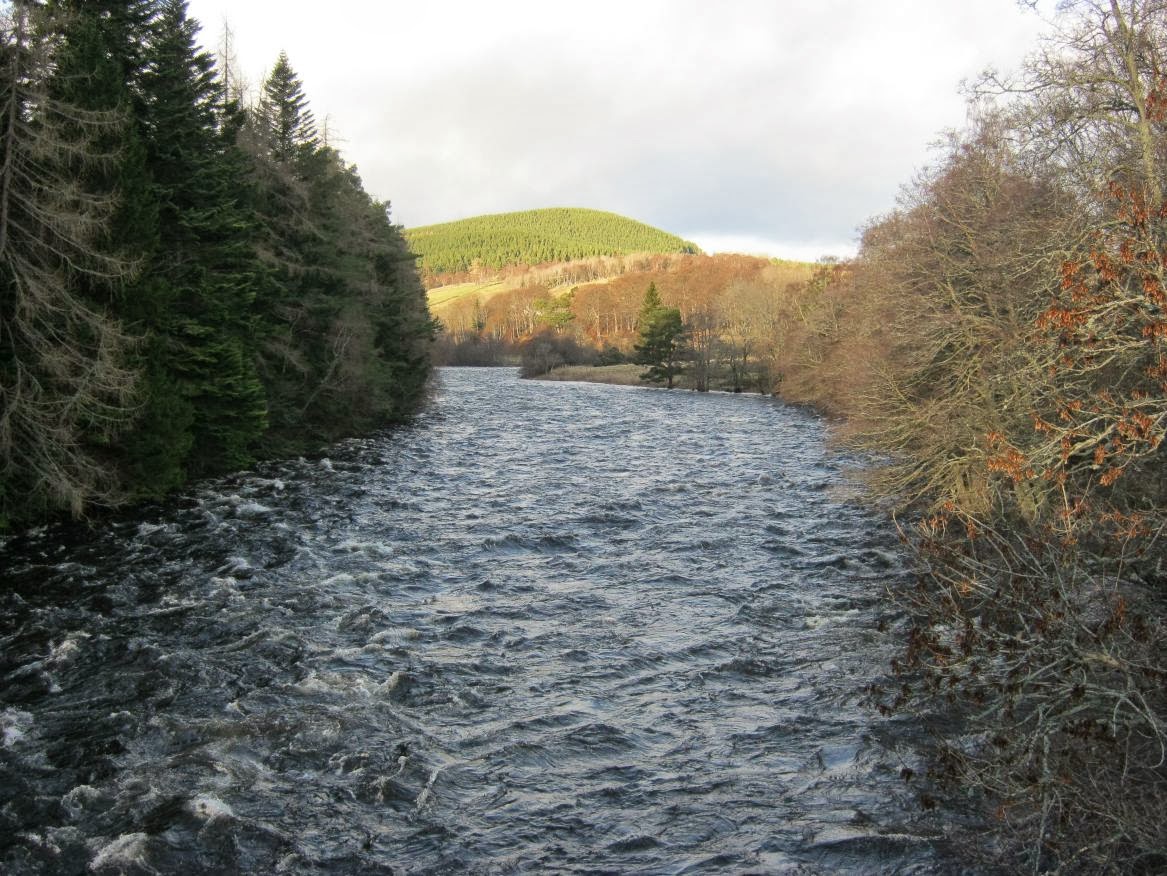
| The River Dee, taken from the bridge built by Brunel |
I walked up to find Victoria's cairn and was treated to a spectacular view as I came upon it:
| Queen Victoria's cairn |
My books don't take sides when it comes to the class warfare of the 19th century. My job as author is to show the story from all possible sides, which is why in The Atholl Expedition I picked characters from every possible level of the social spectrum. All of these people have qualities both good and bad. Some may criticise me for portraying the Royal couple in a positive light, perhaps wishing that I had instead pursued some political or social agenda in my novels, but I see no need to take sides in a war that is no longer being fought (or, at least, no longer being fought in the same way or on the same fronts).
Gelder Shiel
After exploring Balmoral I walked to Gelder Shiel in increasingly strong winds; however, the weather was otherwise good and, despite the forecast, I convinced myself that the next day would be acceptable for climbing.
Gelder Shiel is a comfortable little bothy and I spent about 15 hours there in total. Once unpacked, I spent a fair bit of time writing up notes from my research I'd carried out in the Balmoral estate, and fleshing out ideas for my next book.
| At Gelder Shiel |
I started the walk-in to Lochnagar just before dawn. It felt pretty windy in Glen Gelder but I was confident things would improve later on. The sky was clear and I was treated to some absolutely stunning cloud and light effects as the sun rose.
| Dawn |
| A herd of red deer |
| The approach to Lochnagar |
As I climbed, the crusty snow lay in deeper drifts and it got windier ... and windier ... and windier!
| Above the snowline |
| Ominous lenticular clouds |
| On the way down, an expansive view of the Balmoral Forest |
Remarkably, all three hostels in Braemar were closed so I was obliged to take a room at the Fife Arms Hotel.
The retreat
With several days left until I had to go home, you'd have thought I would have jumped at the chance to explore some more areas and climb some more mountains. However, all the mountains accessible from Braemar are big days, usually requiring a stay at a bothy, and the forecast from Friday onwards was pretty bad - I didn't fancy being blown off another mountain. I considered doing one of the smaller hills, but to be honest that would have meant staying another night at the hotel, and I had started to feel a little apathetic about the entire trip. I suppose my failure on Lochnagar disheartened me a little.
My research work - the main reason for coming in the first place - was done; I had been beaten by Lochnagar, the mountain I really wanted to climb; any other objectives were purely secondary. I decided to return home on the first train the next morning.
Despite my failure to climb any mountains at all, this has actually been a very successful trip. I've done a lot of highly useful field research, and perhaps more importantly, my sojourn at Gelder Shiel allowed me some thinking space and I have already planned out about half of my next book...
Thursday, 31 October 2013
The magic of early winter in the Highlands
Exactly five years ago I was standing on a mountain ridge in Glencoe, spindrift blasting in my face and rejoicing in my first winter climb of the 2008/2009 Scottish winter season.
It was an exciting time for me. I'd moved to the Clachaig Inn about a month earlier as a barman, and I was still a little dazzled by my new surroundings. I'd enjoyed some great days out on the hill already (most in pouring rain, it must be confessed) and now it had snowed!
I was so excited that I headed out on the hill before a five o'clock start behind the bar, desperate for my ice axe to see some early season action. In my inexperience I chose the Sron na Lairig ridge as my target.
| The Sron na Lairig arete (Grade II) |
The unique challenges of early winter
I had never climbed in such thin conditions before. The hills may have looked white, but I soon discovered that the covering of snow was little better than cosmetic on most slopes. The wind had, however, blown it about and sculpted it, depositing some appreciable snowdrifts on some aspects. There had also been a good freeze/thaw cycle already, and I was keen to get into some 'mixed' climbing.
Mixed climbing involves a mixture of snow and iced-up rock, and I have never been very good at it...
| A difficult step |
As I was soon to discover, most of the steps on this ridge were actually rather harder in lean conditions, and I ended up weaving from side to side a great deal to avoid sections of excessive difficulty. I was alone, after all, carried only a single walking axe, and was not a very experienced climber at this point.
Conditions may have been lean overall, but in places the ice was thick and satisfying.
| Thunk |
The wonder of two worlds
Two different worlds coexist during your first snowy outing of the season. Down there in the glen, the light is soft, the stags are roaring, the warm colours of copper and tan dominate the landscape; leaves cling to the trees despite the frequent storms, and occasionally a burst of warmth reminds the walker that it was summer not so very long ago.
But up there on the heights, winter has made its first incursion in a campaign that will last for many months.
The light is special at this time of year, and the snow is all the more precious because you know it will be fleeting, and the usual service of wind and rain will resume shortly.
| Autumn and winter coexisting |
Eventually I climbed to the base of a tower that I could not climb and could not circumvent. In such conditions, the lower steps were slabby and committing. There was one move I could not commit to: a big step up onto a steep wall, with no guarantee of easier climbing above. Perhaps if I'd had a second ice axe I could have made the move, but five years ago I had not soloed many winter climbs and I didn't have the courage to do it.
I looked for a way around but could not find one. That meant I had but one choice: to find a different route to the top.
I traversed right off the ridge crest and climbed a short Grade I snow gully, unnamed to this day as far as I know although the Glencoe climbing guide mentions a number of easy snow gullies between Sron na Lairig and the East Face of Stob Coire Sgreamhach (a huge face partially explored by my brother James).
| The gully. Lots of lovely frozen turf! |
I ran over the frozen landscape, accompanied by the scurrying fair-weather clouds and the icy wind.
| The long drop into Coire Bheith |
I made it - just. I exploded through the doors of the Boots Bar at two minutes to five, dripping with perspiration, a chunk of ice still encasing the blade of my axe. It was Octoberfest at the time and the bar was full of punters, mostly clad in mountain gear, quaffing ale and eating haggis after a day in the mountains.
I changed into my uniform and started pulling pints, tired from my rapid descent but glowing with satisfaction from within. I had climbed my first route of my first full Scottish winter season, and I knew the next few months would be filled with adventures and stories waiting to be told.
Wednesday, 7 August 2013
The 2013 #Scotwinter Sweepstakes: place your bets!
We are on the verge of that special time of year when the mountaineer's thoughts begin to turn to the big question: when will the snow return? For the UK's highest mountains, summer is a brief pause. If you find yourself pondering the first snowfall question in August, you know you've really been bitten by the Scottish winter bug!
In the spirit of enthusiasm I propose a sweepstakes.
~ THE RULES ~
1. For the purposes of this competition (which isn't to be taken too seriously) I shall judge 'first snowfall' to count as the first snow that settles on one or more Scottish mountains for more than a few hours.
2. Tiny flurries that melt as soon as they hit the ground can occur at any time of year and don't count.
3. Place your bets by commenting below or by tweeting me at @alex_roddie. Alternatively there is a UKC thread where you can place your bets. You only get one guess and can't amend it a few weeks later based on more accurate forecasts. I'll record all bets in this blog post.
4. You can choose either an exact date or a given week (eg. "first week of October"). Saying "some time in November", for example, is too vague!
5. Winners specifying a week range shall receive a free digital copy of one of my books of their own choice. I hope to have released The Forbes Challenge by then so people who have read my two existing titles should have something new to look forward to!
6. Winners specifying an exact date shall receive a paperback copy of The Only Genuine Jones.
~ THE ENTRIES ~
@alex_roddie 1st week of September
Lew13 2nd of September (on the Ben)
Cameron94 3rd of September
Simon Yearsley 4th of September
keith-ratcliffe 4th of September
Simon Caldwell 5th of September
Iain Cameron 8th of September
@Caleyscribbler 10th of September (above 2,600ft in Lochaber)
@FlintyRich 10th of September at 12:27pm
@fbroon79 14th of September
@greedyrunner 15th of September
@Barry_the_cat 3rd week of September
@CountrysideBen 3rd week of September
@edvones 3rd week of September
cfer 17th of September
Daniel Sutherland 18th of September
@Spacemouse77 19th-21st of Sepember
Chris Sleight 20th of September
@rossmacscot 21st of September
wee jamie 22nd of September
Chris Sleight 20th of September
@rossmacscot 21st of September
wee jamie 22nd of September
Cookie (North East Wales MC) 23rd of September
TobyA 23rd of September
@DavieRob10 24th of September
NottsRich 24th of September
@andyblackett 25th of September
crowberry gully 25th of September
fire_munki 25th of September
alooker 27th of September (morning)
@BathosProfundo 27th of September
@IrishHillwalker 29th of September
SeanB 29th of September
Jim Walton 30th of September
Susan Fletcher 1st of October
Goose299 1st week of October
Jennifer Will 2nd of October
Ann S 3rd of October
Gareth Lynn 4th of October
@walkhikeaholic 9th of October
neon_blue 12th of October
Andrew Mallinson 13th of October
NottsRich 24th of September
@andyblackett 25th of September
crowberry gully 25th of September
fire_munki 25th of September
alooker 27th of September (morning)
@BathosProfundo 27th of September
@IrishHillwalker 29th of September
SeanB 29th of September
Jim Walton 30th of September
Susan Fletcher 1st of October
Goose299 1st week of October
Jennifer Will 2nd of October
Ann S 3rd of October
Gareth Lynn 4th of October
@walkhikeaholic 9th of October
neon_blue 12th of October
Andrew Mallinson 13th of October
@StrachanHazel 14th of October
@CliveVardakis 16th of October
@pixiepippi 17th of October
@CliveVardakis 16th of October
@pixiepippi 17th of October
Melanie Holdsworth 17th of October
Richard Prideaux 3rd week of October
@nickbramhll 21st of October
@ArrocharAlps 24th of October
Joak 24th of October
@Areteroute 27th of October
Richard Prideaux 3rd week of October
@nickbramhll 21st of October
@ArrocharAlps 24th of October
Joak 24th of October
@Areteroute 27th of October
DundeeDave 1st full week of November
Martin Rye 15th of November
tattoo2005 6th of December
abseil 5th of February 2014 (bit pessimistic this one!)
Martin Rye 15th of November
tattoo2005 6th of December
abseil 5th of February 2014 (bit pessimistic this one!)
Monday, 5 August 2013
The mountains of my life: Ben Nevis
This blog post is part of a series of articles on mountains that have a special significance for me. See also: Bowfell, Tryfan, Stob Ban, Castor, and Aonach Dubh.
Like most people, I first climbed Ben Nevis via the Pony Track: a relentless grind up the bleak western flanks of the mountain. It was only my second visit to Scotland, in September 2006. I had only climbed a handful of Munros to date, but I was ambitious and impatient to build up my mountaineering credentials,. Ben Nevis seemed like the natural choice.
I was staying in Glen Nevis and had just ticked off the Ring of Steall in a two day lightweight bivvying expedition. Blisters plagued me and the forecast was terrible, but undeterred I crossed the River Nevis at Achintee and set forth on the adventure.
The Pony Track is an unrelenting grind up a stony zig-zag. The difficulty of the walking is very low, but it goes on and on; even on a fine day, it's unlikely to be memorable for aesthetic reasons. People climb the Pony Track simply to get to the highest point of the UK. It's far more useful to climbers as a quick way down.
| A gap in the cloud |
I got to the summit in thick mist, saw a lot of stones, and thought to myself that Ben Nevis wasn't that good a mountain after all. I naively thought I had 'done' Ben Nevis, but as I would come to appreciate over the next few years, I had seen only a tiny proportion of this grand mountain.
~ FIRST EXPERIENCE OF THE NORTH FACE ~
| James climbing the lower steps of Castle Ridge |
By early 2008, James and I were getting into more serious climbing and we decided to revisit Ben Nevis. Our trip coincided with some grand conditions on the North Face and we selected Castle Ridge as our first route. At the time we had some experience on Grade II climbs but had never attempted a III before. Castle Ridge would be our first.
| Me belaying above the crux |
We were fortunate to find the ridge in benign condition: a thick lathering of powder on top of old, firm neve, and the rocks largely free of rime ice. However, several sections were quite difficult and I climbed the infamous crux chimneys after a committing battle. Nowadays this section is frequently given a technical grade of 4 and Castle Ridge has a reputation as a 'cruxy' III. Nevertheless, both of us managed to heave ourselves over this fierce obstacle. The rest of the ridge was easy.
~ LEDGE ROUTE ~
I had previously scrambled up Ledge Route (the easiest climb on the North Face) in summer 2008 with the UEA Fell Club, and was keen to try the route out in winter conditions. It's one of the best Grade II climbs in Scotland and frequently soloed. At that time I hadn't done much soloing in winter, but headed up there in the first week of December with my bivvy bag. It snowed heavily overnight (waking up was certainly uncomfortable!) and getting to the start of the route required a bit of a wade.
| Post-route photo. At that time I climbed in a ragged old garment which became known as the "Death Smock." It wasn't waterproof but it was very lightweight! |
Ledge Route became a favourite, and in 2009, 2010 and 2011 I managed to climb it after the first snowfall of the winter (usually October).
~ THE CMD ARETE ~
| May 2009 |
Ask any ambitious mountain walker which is the best way up Ben Nevis, and 9 out of 10 will tell you it's the CMD Arete. This shapely ridge connects Ben Nevis with the peak of Carn Mor Dearg and provides a link with the chain stretching east to the Grey Corries. The route is technically easy but has a distinctive elegance and is a coveted route for aspiring mountaineers.
I first traversed the arete on a beautiful morning in May 2009. The previous day I had bivouacked in the huge corrie east of Aonach Beag, and in the early hours I climbed a Grade III ice route on the immense North Face: perfect ice and deep snow, but with the constant risk of avalanche in the rapidly warming conditions. From Aonach Beag I made my way over to Carn Mor Dearg and paced out the arete before crossing the summit of Ben Nevis and making my way back down to Glen Nevis. It was an unforgettable journey, made more special by the unusually good late winter conditions.
The view of the Ben's North Face from the arete is unsurpassed from any other viewpoint. In this photo you can get an idea of the sheer scale of this wall.
I went back and crossed the CMD Arete for a second time in November 2009 with my friend and fellow wanderer Isi Oakley. Conditions were very different that day - more atmospheric, less Alpine. The sunset from the summit was sheer magic and I have never seen light like it before or since.
~ THE GREAT RIDGES OF NEVIS ~
The Ben's North Face throws down a brace of ridges into the corrie beneath, several of which are steeped in legend and mystique. By summer 2009 I had already climbed the lesser two of these ridges (Ledge Route and Castle Ridge) but three remained: the world famous Tower Ridge, the gigantic North East Buttress, and the relatively obscure but technically challenging Observatory Ridge. That summer I would tick off two of these ridges.
I climbed Tower Ridge on my birthday, the 3rd of June 2009, and once again Ben Nevis delivered an unforgettable day out.
| Me beneath the final tower |
Winter still gripped the cliffs, but reports indicated most of the snow had gone from Tower Ridge. Isi and I opted for a lightweight approach: we took only a 100ft rope and no technical equipment, although I opted for rigid boots and a long ice axe in case any steps needed to be cut. Most of the ridge was indeed bare rock, although the cave pitch was filled up with hard ice that needed to be cut to allow a through passage.
| Isi in Tower Gap |
These were the days before the Tower Gap rockfall and we negotiated this infamous obstacle with relative ease. Nowadays a block has been detached which makes descending into the Gap more difficult.
Once again we topped out to stunning views over the mountains of Lochaber, and descended at speed. We reached Glen Nevis before 11am - a truly fast and light expedition!
James and I returned to tackle the North East Buttress a few weeks later. This ridge is quite a bit longer and harder than Tower Ridge, and thanks to its lower level of traffic maintains a slightly wilder feel. On Tower Ridge the right way is rarely in doubt; on NE Buttress a labyrinth of possible routes stretches out ahead of the climber, and the hard bits are much harder!
| The gargantuan outline of NE Buttress, one of the biggest rock climbs in the UK |
We wasted a lot of time just trying to find the First Platform, hidden behind the back of the ridge, but once we found the start of the route we made good time.
| James changing footwear at the First Platform |
| "Es geht?" |
I enjoyed the NE Buttress tremendously. Although we took more modern kit and pitched more of the route, it felt like a good old-fashioned rock climb: noble, defined, and ending at a major summit. The difficulties were testing but not too dangerous, and famous pitches such as the Mantrap and the 40 Foot Corner lived up to their reputations. I found myself incapable of surmounting the Mantrap and was forced to avoid it by a dodge to the right.
| The 40 Foot Corner |
~ FURTHER TRIPS TO THE BEN IN WINTER ~
I never climbed on Ben Nevis again in summer, but returned several times in the winter months to sample the almost limitless possibilities for ice climbing contained within the various corries of the North Face.
Over the years I climbed South and North Gullies, failed on Raeburn's Easy Route thanks to windslab, and enjoyed yet another unforgettable climb on No.2 Gully in May 2010. I'll let the pictures speak for themselves. Ben Nevis has always given me quality days out, and even when the weather gods decline to provide the coveted blue skies and sparking ice, the atmosphere of the cliffs never fails to inspire awe.
| South Gully (III) |
| North Gully (II) |
| No.2 Gully (II) |
| Raeburn's Easy Route (II) |
| Ledge Route in October conditions |
| No.2 Gully in May |
| The monster cornice of No.2 Gully |
| The author about to face the cornice pitch |
So there you have it. I have climbed on Ben Nevis many times over the years and it remains a favourite mountain, but it's obvious to any climber that I have only just scratched the surface of the climbing potential on these cliffs. I have yet to climb Observatory Ridge, or any of the classic ice gullies, and I think that's what is truly special about this mountain: there is always more to do and look forward to, regardless of your grade.
Subscribe to:
Posts (Atom)