Showing posts with label research. Show all posts

Tuesday, 19 March 2013

Digital Research: The Double Edged-Sword

Regular readers might remember an article I penned last year comparing modern research and writing methods with those of the 19th century. In "The Post-PC, Post-Print Revolution" I pondered the question of how technology is changing the way we create books. We have a dizzying array of technology at our disposal in 2013--literally miraculous digital powers that give us access to all the world's knowledge with a few keystrokes (or, increasingly, a spoken command). But are these abilities empowering or hindering us?

I was recently contacted by Allison Morris who has created an infographic (below) on this very subject. I thought it would be interesting viewing for my readers, particularly those of you who also write.

Ironically, my dependence on digital resources has, if anything, strengthened since last May. I have found Google Now to be an invaluable research tool: an efficient, always-listening assistant that will listen to my spoken queries and reply instantly (in a very convincing British accent, no less). However, I do still like my notebooks...

Source

Please Include Attribution to OnlineEducation.net With This Graphic Digital Research Infographic

Wednesday, 9 January 2013

Equipment for Victorian climbers: puttees

Puttees

Regular readers will be aware that, during my time in Glencoe, I did a bit of practical research into 19th century climbing equipment. It's a subject that has been very influential towards my writing. The Victorian pioneers climbed mountains in a very different way to the mountaineers of the 21st century, and I think as an author who also climbs, doing a bit of experimentation was an obvious step to take!

My old articles on the subject can be found here, but for the benefit of my current readers I thought I would write some new pieces on the items of climbing gear the Victorians would have used (especially the ones modern readers will be unfamiliar with).

First, the humble puttee.

This is an article of clothing that today will only be recognised by members of the armed forces, as I believe puttees still feature in their ceremonial uniforms. They were introduced in the 1890s to members of the British forces serving in India. In form, they are a simple strip of cloth or webbing, between one and four yards long,  with a thinner strip of stronger material sewn at one end.

This is how they were worn:

Image from http://goo.gl/TcQmx
The band of cloth is wound in a spiral from the ankle up the calf, finally secured by knotting the thinner strap. The entire assembly is designed to keep stones, mud, and snow out of the boot; it also protects the lower leg. Although puttees first saw common use in the military, they were soon adapted by mountaineers, particularly in the first years of the 20th century, to help keep their feet dry and warm in the mountains.

Modern climbers use gaiters for this purpose, nowadays commonly made of Gore-Tex fabric, fastened with a zipper down the front. Gaiters are waterproof and quicker to put on and take off. They do not freeze or fray, and commonly have a lifespan of many years. There is evidence that some pioneering climbers also used gaiters (made of canvas and laced or buckled instead of zippered).

Me climbing on Ben Lui in 2011.
I'm wearing a puttee on my right foot; the
left one has fallen off!
Despite the many advantages of modern gaiters, my experience of using puttees has led me to appreciate some of their unique benefits. Firstly, they are far more adjustable, and can easily be made as tight or as loose as the wearer requires. Although they are not completely waterproof, they are also more breathable than gaiters and don't make the feet perspire. They are far more durable than Gore-Tex material and can take a huge amount of punishment (a useful quality on an Alpine climbing tour). They are light and highly packable. Perhaps most importantly, a puttee is a very adaptable piece of equipment; it can be used as a bandage, a sling, or torn into strips and turned into a makeshift lashing.

I wore puttees for some of my Scottish climbs, and when climbing in deep snow they certainly keep the feet dry and warm. They froze solid on a couple of occasions, making the straps difficult to untie. Sometimes they came loose and had to be adjusted halfway through the day. In January 2011, when climbing on Ben Lui, the fastening strap of my left puttee actually came off altogether, forcing me to remove it and simply tuck my trouser leg into my sock!

I have recently been trawling Ebay for a new pair of puttees to replace my old worn-out ones. I managed to find two pairs of the short type--the older long ones are incredibly rare and difficult to find--and bought them for only £7.50 a pair in excellent condition. This time I want my puttees long enough to reach all the way up my calf, so I intend to modify them by sewing the two pairs together to double the length. I will be sure to report back on their performance.

In conclusion, puttees are a minor but notable part of our mountaineering heritage. They are a good example of how technology has been used, improved upon, and left behind by the march of progress. As a modern climber, using puttees instead of gaiters is an illuminating experience that helps the wearer understand the unique challenges of mountaineering in the 19th century. The full suite of Victorian equipment (long axe, nailed boots, tweed and all!) fills in the whole picture and is a very special experience, as we shall see in future articles!

Thursday, 3 January 2013

Facts and the historical novelist

Eiger North Face 1897
Fact or fiction? 
The historical novelist has a very important responsibility. Most people stop formally learning about history at school, which means that as an adult, the bulk of our historical education comes from fiction: in the broadest possible sense, that includes books, movies, and costume dramas on the BBC. Historical fact is a precious resource that can be used (and abused) in numerous ways. Some fiction sticks religiously to the established facts and does not deviate to the slightest degree. Other work play fast and loose with evidence and fails at the first hurdle, needlessly introducing anachronisms that will irritate the informed reader.

As a novelist who specialises in the 'faction' genre (the blending of fact and fiction), I believe that the perfect balance lies somewhere in between these two extremes. I take my responsibility as an author very seriously, but I believe the average reader is intelligent enough to appreciate why changes are sometimes made to history in order to craft a good story--if it is carefully explained in a historical note at the end.

Let us consider the first scenario. An author who is unwilling to alter history in any way (or fill in the gaps where evidence is lacking) is enormously constrained. The resulting novel has no give to it; there are no areas where the author can use his gifts of imagination to smooth over the rough edges of history. Historical figures are limited to doing what the official record dictates--and nothing else. Moreover, unless the author is an expert in the period in question, the amount of research is going to be completely overwhelming and will take many years. You will never be able to learn enough to make the story 100% accurate, and you'll get so bogged down in research that the book runs the risk of never getting written.

In the second scenario, the author is intimidated by the idea of becoming an expert on a historical period, and conducts only the most cursory research. Errors creep in and they can sometimes be huge. Who wants to read a book in which a character in 1895 is listening to a radio broadcast ... unless it's steampunk? Readers who know their stuff will feel cheated and may give up on the book, and the less knowledgeable will come away with a warped view of history.

What's my own experience? My policy these days is, I believe, a sensible one for me: I learn as much as I can, then I make an informed choice on what to do with that data. I'm no expert on the 19th century, but I read constantly on the era and never get complacent. There is always more to learn. The history of climbing is a topic on which I have read even more extensively and I think I am finally getting to the stage where I can call myself reasonably well-read on the subject, between certain dates at least; after about 1935 my knowledge is very patchy!

My fiction deliberately makes changes to historical truth: it's alternative history, a subgenre that has produced some amazing 'what if?' stories. I choose a date (in my case, July the 24th 1896) and decide that everything after that point happens in a fictional alternative timeline. If suspension of disbelief is maintained, the reader is willing to accept this, provided the boundary is clear.

Full explanations are always given in a historical note, and changes are only made if there is a good reason to do so. I don't always get it right--readers have emailed to point out minor anachronisms--but I try hard and I think for the most part I do a good job.

SOME EXAMPLES

Fort William old train station
The original Fort William railway station
Fort William in the Highlands is a setting that features on several occasions in my work. In the present day, it boasts a modern train station. The casual researcher might assume that the railway station was always on that spot, but in fact when it was first built in the mid 1890s, it was some hundreds of yards from its present location--and looked completely different.

Fort William old train station map
Map of the Fort before the old station was demolished
in 1975. The new station is just beneath where it says
'Distillery'.
In my book it is quite clear that the terminus is in the old location, next to the Loch. One reader, familiar with the town, emailed me to point out this 'error' but in fact this is simply an example of historical truth being carefully applied. Fort William has changed significantly since 1897 when my novel is set.

Bear Hotel, Grindelwald
The Bear Hotel, Grindelwald. It no longer exists.
The Alpine town of Grindelwald, another location in OGJ, has changed even more drastically since 1897. I visited the town in 2010 to conduct research on the ground (a tactic I am a huge believer in, because it makes a place more real and you are free to explore in a way you cannot through the pages of a book). In OGJ, the characters stay at the Bear Hotel for a few nights. I wanted to find this hotel and have a look around to see what I could discover about its interior. How had it changed since the 1890s, I wondered?

I spent an entire day searching for the Bear Hotel before concluding that it no longer existed. A sports centre now stands on the promontory of land once occupied by the hotel. Unable to investigate the hotel in real life, I did my best with books and some old colour postcards of Grindelwald from the 1890s.

Pelton Ring karabiner
The Pelton Ring
One area where I have made subtle changes (while sticking within the boundaries of historical possibility) is climbing equipment. Readers will be aware that I have introduced the idea of short ice axes, crampons, karabiners, and pitons--all years before they became mainstream items of equipment amongst climbers.

However, I have done nothing historically impossible. Karabiners did in fact exist in 1897; they were patented in 1868 by a Mr Pelton (see diagram). Crampons had been used for many years by climbers and the addition of front points was a minor innovation that may have happened at any time under the right conditions. Even pitons had been used by climbers in various forms since at least the 1860s.

I am very careful to do nothing in my fiction that breaks suspension of disbelief, and while several events in The Only Genuine Jones might stretch it, that very quality has proven popular with readers. It's a bold story and most people seem to like that.

I tread a delicate line between fact and fiction, but I think my approach has many advantages: I don't pretend my work is a depiction of true events, and I enjoy a degree of flexibility denied to the strict historical author. I get to explore ideas and tell stories that otherwise would never see the light of day. However, I am very conscious of my responsibility as an author and would never want readers to confuse my stories with strict historical fact.

What do you think? If you're a historical novelist, what is your approach? As a reader, how much historical fact do you like served with your fiction?

Wednesday, 5 December 2012

Oscar Eckenstein: the first true innovator of climbing equipment?

Eckenstein Grivel crampons
Eckenstein prototype "Ice Claw", or crampon, in my personal collection
"What the ice climbers of the future will be able to climb, I know not. But I find it hard to believe that we have already reached the limits of what is possible."
--Oscar Eckenstein, from his 1908 article on the future of ice climbing 

Oscar Eckenstein was an English rock climber and Alpinist of Jewish descent. By profession a railway engineer, in his leisure time he climbed in the Alps, the Lake District, and Snowdonia. He was a member of the early community of climbers who helped establish the foundations of the sport as we know it today.

By all accounts a difficult man to get on with, he had few friends but climbed with many of the pioneers. He was a particular friend of Aleister Crowley, O.G. Jones, and the Abraham brothers. I chose to use him as a character in my novel as I find him fascinating: pricky and easily offended, yet unassuming in the mountains (he rarely led routes) and the owner of a brilliant technical mind.

In this article I will talk a little about Eckenstein's greatest contributions: his inventions and new techniques. This is an important subplot in my book so readers may be interested in learning a little more on the subject.

First, some context. In the 19th century, ice climbing went through several phases. In 1800, the Alpinist generally carried a baton or Alpenstock, which is a simple wooden pole shod with a steel spike. Climbers wore ordinary hobnailed boots on their feet, and generally wore crampons of some description (usually ill-fitting devices with four points, although other types were used). The guide carried a small axe, often an ordinary hatchet, which he used to cut steps for the rest of the party. Some very difficult routes were climbed with this method, generally through the icefalls of glaciers; but ice climbing was simply a means to an end, ie. to ascend the peak by the easiest route.

Next, some climbers started combining the two tools of hatchet and baton by adding a pick or blade to the top of the pole. The average baton length also decreased over the course of the early 19th century.

The ice axe as we know it was born at some point in the 1850s, when most ice axes had a two-part head composed of a pick and an axe blade. During the course of the 1860s the blade turned horizontal (an adze) as this was found more convenient for cutting steps in snow. The axe was still generally very long at this point; anything between a metre and a metre and a half.

The use of crampons fell out of favour gradually in the middle part of the 19th century. By the 1890s, crampons were not generally used by British mountaineers, thanks to the advanced art of nailing boots. Edward Whymper's condemnation of crampons also helped to hasten their demise.

Ice climbers had grown used to the hazards of ascending steep ice: no safety from the rope, laborious step-cutting requiring enormous strength and stamina, slow progress over terrain often threatened by avalanche or rockfall. The technique of climbing was largely dictated by tradition and methods passed down from father to son. Climbers relied on their guides to do the hard work and keep them safe. Although by the early 1890s British mountaineers were encouraged to learn the craft of step-cutting, the average climber rarely had to put it into practice if he employed guides.

Guideless climbing became more usual in the mid to late 1890s, thanks to the exploits of A.F. Mummery and other leading figures. Suddenly climbers realised that ice climbing was damned hard and dangerous work. Interest began to grow in ways of making it faster and safer.

Enter Oscar Eckenstein.

He was the first man to apply reasoned, scientific thought to the craft of climbing ice. In the first years of the 20th century, he worked with a blacksmith named Henry Grivel, who lived in the Alpine town of Courmayeur. His vision was a simple one: to resurrect the crampon, and make it the centrepiece of a new advanced technique of ice climbing.

Grivel crampon
The original blueprints for the Eckenstein ice claw, from Alpinist magazine http://goo.gl/caXX9
The Eckenstein-Grivel crampon was a masterpiece of design for its day. It was designed to fit well (this would solve many of the problems of previous crampons). It was designed to be light, yet made of quality steel and very strong. It had ten long, sharp points to each boot. In short, it was the very first modern crampon which would actually be of use rather than a hindrance to the climber. Instead of cutting thousands of steps, the climber could simply walk up steep ice by turning his ankle and engaging all of the points with the slope. This was revolutionary stuff: it would make ice climbing faster and easier (hence safer).

Eckenstein's new technique demanded a revised ice axe. He designed a new model with an 80cm shaft, short enough to be used by one hand. Nowadays we may balk at the idea of one-handed cutting with an 80cm axe, but in 1908 this was a radical improvement. With Eckenstein's system, only occasional steps would need to be cut at the most difficult places.

Stubai Aschenbrenner
The head of an ice axe similar to the one Eckenstein designed. The basic pattern was still in use 70 years later; this is a Stubai Aschenbrenner from the 1930s-1950s.
It was slow to catch on. Grivel manufactured them, but British Alpinists regarded them with suspicion and step-cutting continued to be the norm for several decades, into the 1930s and the 1940s in some areas. In Scotland, some climbers continued to prefer climbing in nailed boots (albeit with much shorter gully axes) well into the 1960s.

But the revolution had begun. By the end of the 1960s, a new generation of scientific minds had refined Eckenstein's idea yet further, using radically curved ice axes to climb directly up vertical ice. Front points on their crampons allowed them to walk up the steepest terrain without having to engage all ten points. (Front points were added in the 1930s, but again not generally used for this purpose until much later).

In the present day, climbing is a very different game, but the Eckenstein heritage is still obvious to see in the tools we use to climb. I own a pair of G12 crampons--still manufactured by Grivel in Italy, and although the design has changed, the philosophy has not.

Grivel G12
The Grivel G12 crampon (2000s)
Comparison between G12 and Eckenstein prototype
Comparison between the Grivel "Alp Wing" ice axe (c.2009) and Stubai Aschenbrenner. One is designed for front-pointing ascents, the other cutting steps.
How does all this fit in with my work? In my novel, The Only Genuine Jones, Eckenstein takes his inventions further than he ever did in life thanks to a collaboration with Crowley, opening up a world of new possibilities. History is changed forever. Do I believe this could have really happened? Perhaps; given Eckenstein's genius and Crowley's drive, it would be surprising if they didn't concoct something wonderful between them. Ultimately my story is a whimsical 'what if?' look at the history of mountaineering and certainly shouldn't be taken seriously.

Monday, 15 October 2012

The writer's notebook(s)

Notebooks are about feel, mood, and introspection--not utility.
Before I begin this post celebrating notebooks, I have a confession to make: I hardly ever use them. I write historical fiction set in the 19th century and love the aesthetics of that era, but am also a self-confessed computer geek. This is something of a contradiction--one I have learned to live with.

I have previously blogged about technology for writers, and to read my previous posts on the subject you might be forgiven for thinking all of my writing is done digitally. The fact is that in the second decade of the 21st century nobody has any excuse to still be using paper for the majority of their writing; it's inefficient, environmentally unfriendly, generates waste, and requires physical storage space. Filing and indexing is time-consuming (and if you try not to bother, you will never be able to find anything you write down). Writing by hand is slow and editing is difficult. For these reasons, the bulk of my writing is done by computer in various forms; this includes note taking, research, and drafting.

And yet ...

There's something about physical notebooks that cannot help but touch the soul of a writer. A computer is efficient and can do a dozen things at once, but let me turn that around: a notebook has value precisely because it is inefficient and can only single-task.

When you write in a notebook, you are focusing on a single thing at one time. There are no distractions fighting for your attention. You are consumed with the task of composing words into sentences using the age-old instrument of a pen or a pencil: a process which is slow and primitive compared to typing, but sometimes what we need is to slow down and focus for things to snap into place. Twitter, Facebook, and all the other powerful tools of a modern writer's existence are temporarily obliterated. It is the ultimate minimalism in writing.

This brings me to the second benefit of notebooks: tactility. A writer's notebook is far more personal than a .TXT file containing your thoughts, stored somewhere in a computer's memory. Handwriting itself conveys personality and mood, and in a notebook one is free to doodle, draw, and map out ideas. They become a tangible connection between our moods and thoughts at some point in the past, and the point at which we are reading this information. A data file cannot do this.

Notes taken in 2010 during my trip to Grindelwald. Left is a sketch for the 1897 Eckenstein ice claw; right are some of my initial ideas for a future novel.
How do I use notebooks? I use pocket Moleskine journals whenever I travel for research purposes. These books are tiny and very resilient; I currently have a collection of 12 which document every research trip I've made over the last five years. They chronicle my investigations in the streets of Zermatt and Evolene, the peaks of the Alps, and the valleys of the Lake District. When I read their pages--which are often smudged by rain or dog-eared by travel in a rucksack--the tactile nature of this recording medium takes me back to the place in question more surely than any digital file could.


Notes from a trip to Wasdale Head. +1 for anyone who gets the significance of this page in the context of The Only Genuine Jones.
I also keep a large 'project sketchbook' for important drawings and plans. In this book I draw maps, family trees, designs for equipment in the fictional Jones universe, and anything else that requires a larger canvas.

Do you still use notebooks? How do you use them, and how do they integrate with your digital methods of writing? I'd be interested to hear any views!

Wednesday, 25 July 2012

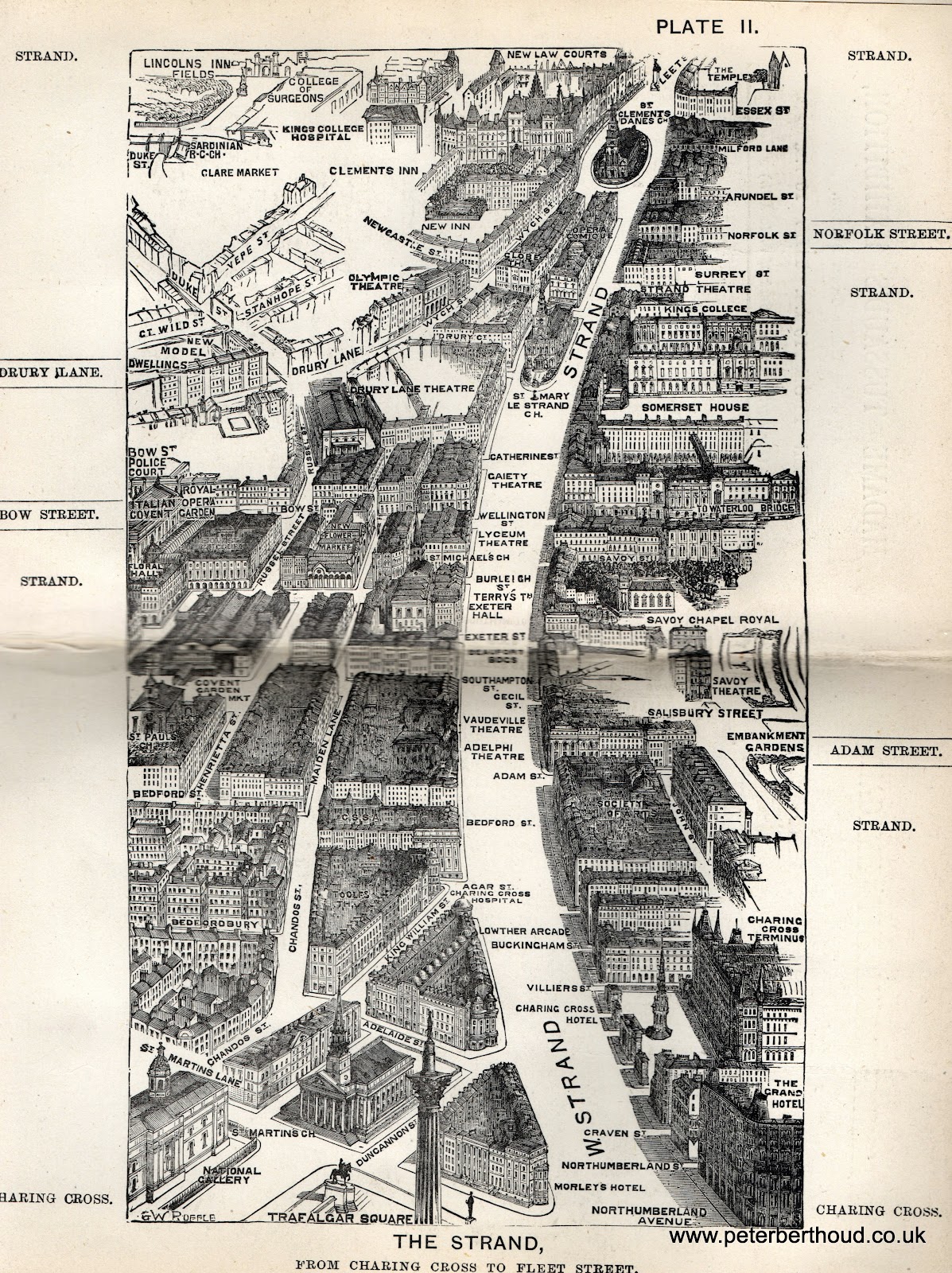
Aerial views of London from 1891

The Strand in 1891
a key setting for my work
Image credit:
http://goo.gl/7J1CP
Although I have never lived in London and only visited on rare occasions, the sprawling Victorian metropolis plays a vital role in my work. Many of the leading British climbers of the era lived and worked here. I think when studying the climbers of the past it is all too easy to focus exclusively on their trips to the mountains, which would after all have only been a tiny fraction of their lives as a whole. To understand these men and women, one must also understand London (if it's ever really possible to understand the city!)

The Only Genuine Jones may be already written, and my primary research phase for 1848 may be over, but I never stop learning and every day I scour the internet for new sources. I find this learning process endlessly fascinating. There are some real gems out there available for scrutiny, notable among them the Dictionary of Victorian London, and The Cat's Meat Shop.

Today I discovered this excellent article on a range of aerial views of London dating from 1891. The images are in high resolution and are of excellent quality. It's this kind of superb resource that makes historical research such a pleasure. Londoners will also find it interesting to compare the modern city with the metropolis of the late 19th century.

Sometimes I think that some climbing books suffer from focusing too obsessively on the climbing. Five years ago, when I was obsessed with the mountains and had few other real interests, I probably would have been producing similar kind of work ... but now I try to look at my stories from a broader point of view. The 19th century was an incredibly vibrant time and it would be a shame to restrict the view to climbing and mountains.

Monday, 30 April 2012

A gold mine


Just when I thought I was coming to the end of the research I have to do on my new project, something else has turned up to demonstrate just how little I know! I've been doing some research into Albert Smith, a popular mid-Victorian writer, and in the course of this paper trail came across a treasure trove of scanned information on Google Books.

Firstly, three novels by Smith, written in the late 1840s: his 'natural histories', namely The Flirt, The Gent, and Stuck-Up People. These are short satirical looks at popular stereotypes from the decade, and are therefore vital background reading—not to mention the fact that reading them will give me insights into Smith's character.

I really struck gold with the second find. A link from Smith's page took me to a 627 page scan of the Comic Almanack 1844-1853, which is a panoramic look at the humour of the mid 19th century. It features hundreds of illustrations, many by George Cruickshank, and a lot of the comedy remains funny even from the distant perspective of the present day. A cursory scan through has revealed that I simply can't afford not to study this book. It has the potential to revolutionise my knowledge on the period, and therefore cannot be ignored.

Unfortunately it's impossible to know everything about any period of history: a writer could spend his entire life studying it without being satisfied. The time always comes to draw a line under research and move on to other things. The real trick is saying 'enough', and finding a happy balance.


Thursday, 19 April 2012

The boundary between research and prewriting

I'm gradually coming to the end of the research I originally planned for my new book. Since this project is set in a period of time that was until recently unfamiliar to me, the reading list was huge and the list of things to research even longer. I'm very much of the 'massive detail' school of thought when it comes to planning a book; if I know all that can be known about a subject, my logic goes, then that detail will produce a richer story even if I only use a fraction of it directly.

My topics of research have covered everything from glaciology to cartography, from gambling to theatre, from music to popular fiction. Finally I'm nearing the end of the pile of work I originally set myself when I started. As usual, the pile grew as I found other avenues of investigation, and as usual I tended to get carried away with the research at times, perhaps losing track of my final goal in the fascinating tangents I found myself in. But unlike some writers, who feel the need to stick very strictly to their original plans, I embrace these tangents and believe they enrich my work.

The thing I find hardest to cope with is admitting to myself I've done enough. I enjoy research so much--that magical period in a book's lifespan when you discover possibilities every day and the opportunities seem limitless--that I don't like it to end! I find myself approaching this boundary now; I only have one book left to read and make notes on, and realistically I don't have to make any physical visits to my settings, as I have been there and made notes in past years, in anticipation of this moment.

The next phase is where the real work begins: prewriting and planning. Time to turn a mess of vague ideas into a concrete scheme.

Thursday, 12 April 2012

Terra Incognita

Part of my research for 1848 has involved a study of the cartography and glaciology of that decade. The Alps were only partially explored, despite Chamouni (modern-day Chamonix) being almost permanently overrun by tourists from every corner of Europe. Mont Blanc had been climbed dozens of times, but most other areas of the Alps slumbered in obscurity and only a few scientists had begun the laborious process of exploring the rest of the region. Entire valleys remained unknown to outsiders.

A study of Alpine maps from the 1830s and 40s is fascinating. Keller's map was still the authority, proclaimed by Albert Smith to be 'singularly faithful', yet Forbes complained of gross inaccuracies in almost every part of the map--to such an extreme extent that entire mountain ranges were missing, in the wrong place, or even completely made up.

Forbes worked on an abridged version of Keller's map, incorporating his own data. The result is, in places, startlingly modern. The region around Col Collon and 'Col d'Erin' (now Col d'Herens) can be easily compared with modern maps, and of course the Mont Blanc chain was comprehensively explored by Forbes himself so is represented here with a reasonable degree of accuracy.

Other regions still betray the general level of ignorance, mystery, and superstition that would continue to obscure the Alps well into the 1850s. For example, west of Col Collon is depicted an enormous glacial mass called 'Charmontane', larger than the Grenzgletscher; in Forbes' book this is referred to several times as a mythical 'ice mountain' yet to be explored.

Here is a sketch map based on Forbes' chart:


In reality, this feature exists as the Glacier d'Otemma, flowing into Piedmont from the Col d'Charmotane between Pigne d'Arolla and Mont Collon. It is a glacier of some size (and would have been even larger in the early 1840s) but only a fraction of the area shown here, and entirely different in shape.

It's only a tiny detail of the bigger picture, put together from hints in ancient books and irregularities in obscure maps, but it's more evidence that points towards the fact that the Alps were a very strange and unknown place before their comprehensive exploration by British climbers in the 1850s.

Monday, 2 April 2012

Words of wisdom from Professor James Forbes


Professor James Forbes (1809 - 1868) was, in many ways, the first British explorer of the European Alps. Many other British climbers had scaled Mont Blanc, or journeyed throughout the Alps and climbed various mountains here and there--but none of them, until this remarkable man came along, ever made a methodic and scientific study of the mountains on anything like this scale.

Forbes first visited the Alps in an age of ignorance, superstition, and astoundingly inaccurate maps. By the time he published his book "Travels Amongst the Alps of Savoy" in 1843, he had toured every mountain chain in the Alps many times, established his own system for safely traversing glaciers and climbing mountains, solved the mysteries of how glaciers function, and taken the first steps towards accurately mapping the region. Together with less scientific efforts from the likes of Albert Smith, he opened the flood gates and allowed the legendary golden age of Alpine exploration to begin. I think it's no exaggeration to say that, if it wasn't for the almost unbelievable deeds of Forbes, mountaineering as we know it today would not exist.

His book is a marvel of writing, occupying the neutral ground between a scientific document and an adventure story. I have visited the Alps several times over the last few years but his writings really opened my eyes to the remarkable early history of the region, and proved what an alien world the Alps of 1842 are to the modern reader.

Some quotes that I particularly enjoyed:

"Happy the traveller who, content to leave to others the glory of counting the thousands of leagues of earth and ocean they have left behind them, established in some mountain shelter with his books, starts on his first day's walk amongst the Alps in the tranquil morning of a long July day, brushing the early dew before him, and, armed with his staff, makes for the hill-top--begirt with ice or rock, as the case may be--whence he sees the field of his summer's campaign spread out before him, its wonders, its beauties, and its difficulties, to be explained, to be admired, and to be overcome."

"... thought is without fatigue when each passing event gives a varied tone to it and when each step furnishes a new subject for its exercise, and we read the axioms of her philosophy indelibly engraven on the eternal hills." 

"... we turned and surveyed, with a stronger sense of sublimity than before, the desolation by which we were surrounded, and became still more sensible of our isolation from human dwellings, human help, and human sumpathy--our loneliness with nature, and, as it were, the more immediate presence of God. At such moments all refinements of sentiment are forgotten; religion or superstition may tinge the reflections of one or another, but, at the bottom, all think and feel alike. We are men, and we stand in the chamber of death."